Notes on my experience with supporting inductions.
Why induce?
There are several reasons why your obstetrician will recommend an induction instead of allowing you to go into spontaneous labor. You may be approaching your 42nd week of gestation, your doctor may doubt the ability of the placenta to provide enough nutrients to your growing baby, or they may be concerned with the size of the baby in relation to the shape of your pelvis. You may be exhibiting high blood pressure, dizziness, blurred vision, or other symptoms of preeclampsia. Whatever the case for induction, well before you are faced with it as an option, you should be made aware of what it could look like.
Induction methods
Induction methods vary from hospital to hospital, and can be more or less aggressive depending on how the baby and birthing person respond to the medication. Here is some information on some methods that I have seen.
During childbirth, the cervix, or opening at the bottom of the uterus, ripens (softens) and dilates (opens). There are medications that are used to replace the hormones that create these actions during spontaneous labor. When looking up these medications, don’t be surprised if you see they have other medical uses as well.
Fentanyl – This is a local anesthetic that is administered through an epidural needle placed in the lower back using an IV drip. If you are being induced, and you feel the labor pain has turned into suffering, you can ask for a lower dose of induction drugs, a low dose of fentanyl or both. So long as you and baby are doing well, you get to decide what is used to bring you comfort.
Misoprostol – Ripens the cervix, some find it is most effective when administered vaginally as opposed to orally. Read up on the differences, and go with what feels good for you. Given every 4 hours, no more than six times.
Cytotec – Alternative to Misoprostol, also induces uterine contractions.
Foley Bulb (balloon) – This is not a drug, but a catheter that is inserted into the cervix and inflated with a saline solution. Physically opens the cervix to 3cm. You may experience some closing of the cervix after the foley bulb is removed. This is normal – try to stay encouraged by doing labor induction circuit while in bed.
Some report extreme pain upon insertion, while others feel only pressure. The birthing person loses mobility with this method of induction. Sit with this to see if it feels like something you are okay with incorporating into your birth experience.
Pitocin – Oxytocin is one of the main hormones that helps labor to progress. Pitocin is a synthetic form of this hormone. It is given as a continuous drip through your IV and it induces uterine contractions. Side effects include body tremors. Pitocin is often offered after an unmedicated birth to help stop bleeding.
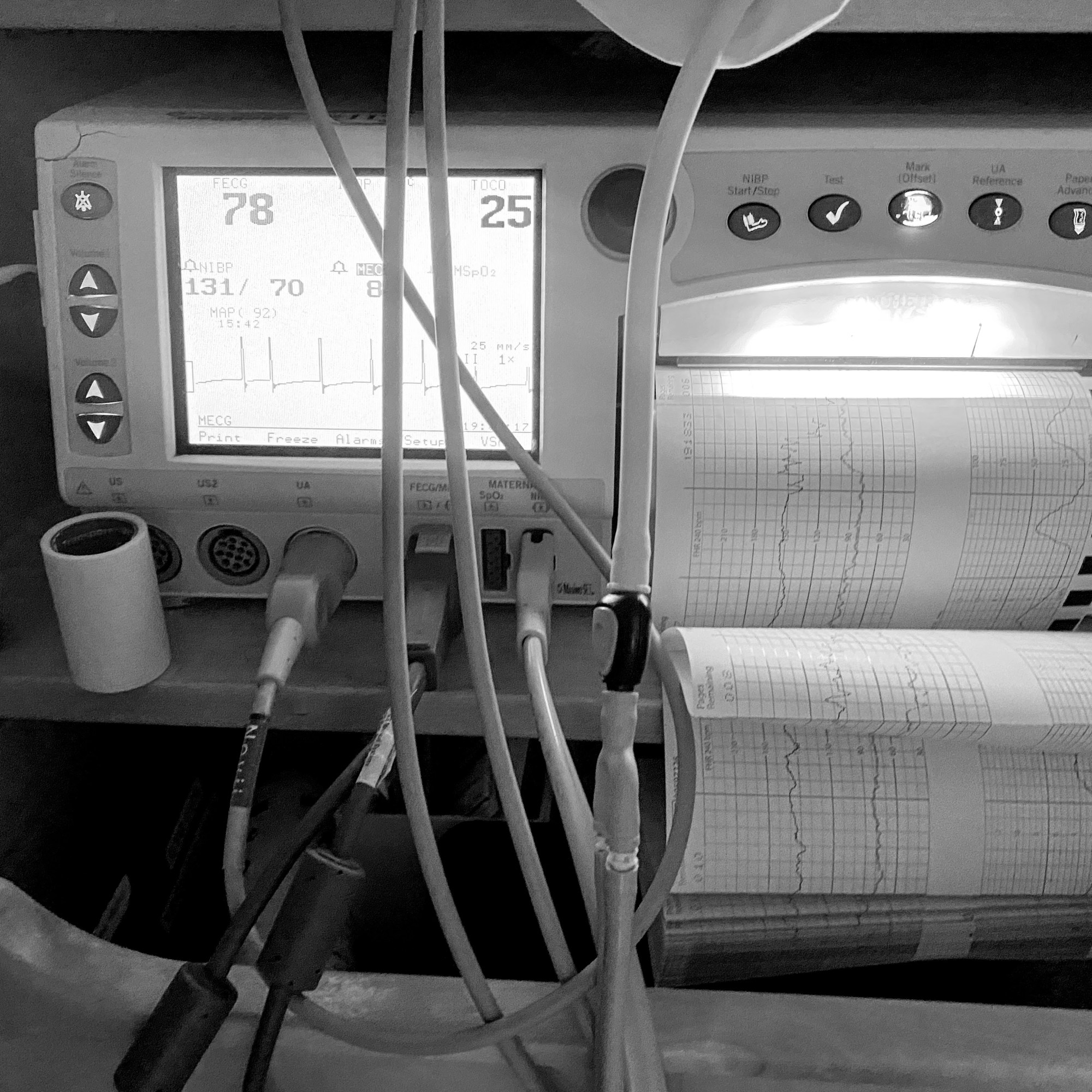
Albuterol – When administered intravenously, this drug is used to stop contractions. From time-to-time, the birth person’s body will respond to induction medications at a rate that puts stress on the baby. Medical staff like to see baby’s heart rate remain between 110 and 160 bpm, with a variation of +/- 5 to 25 bpms within that range. If they believe the contractions are causing baby distress, I have seen the staff rush in with a needle and give the birth person a shot of albuterol in the arm.
Albuterol is also used to treat and prevent bronchospasms in those who suffer from asthma. Folx who use an inhaler will be familiar with this medication.
Inductions and pain medication
Many people who are interested in giving birth without pain medication will attempt an induction with this same mindset. It is okay to stick to that plan while under the influence of these drugs, but keep in mind, many people report that the contractions from inductions are much stronger and thus more painful than those produced during spontaneous labor.
We know childbirth is painful, but we don’t want you to feel you must suffer through a medically induced pain. If you opt for an epidural, don’t beat yourself up about it. You have kept your baby safe for 10 months and should be very proud of yourself.
The 42-week induction
If there is no valid medical reason you are facing induction and you are simply up against the 42-week clock, there are some things you can do to bring on labor without the use of medical-grade drugs.
Please be sure to consult with your doctor before engaging in any of these activities, and especially before taking any supplements.
Walking – If we have the use of our legs, walking can be a stress-free way to create movement in the pelvis. This movement can encourage baby to move down into the birth canal, and put pressure on the cervix, which in turn releases hormones that help to jumpstart labor.
Peppermint and other Essential Oils – Aromatherapy can help to put you in a relaxed state and prepare your body to go into labor. The use of essential oils has also been found to relieve pain and anxiety during labor
Sex (safe if waters have not yet broken) – If your partner produces semen, there are hormones in it that are vital to the progression of labor. They are called prostaglandins, and can help to ripen or soften the cervix. This, coupled with contraction-inducing oxytocin that is released when the birthing person reaches climax (make sure they reach climax, ya’ll!) is a perfect combination to kickstart labor. It doesn’t always work, but you are sure to have fun trying this method.
Nipple Stimulation – For some, nipple stimulation is associated with a lubricating and opening of the vaginal canal. It is known to produce oxytocin which is responsible for uterine contractions. You can use your hands, a breast pump, or the touch of your partner to stimulate the nipples.
Birth Ball Exercises – exercises you review with your doula will help to settle baby into the birth canal. Many of the functions of labor are initiated by hormones that are released when baby’s head creates pressure on the cervix. These movements help body and baby to know that it is time!
Midwives Brew – (mixture of castor oil and other edibles) – You may find information about this online. I am not a medical professional, and so it is not something I offer my families.
The main concerns with using castor oil to induce labor is allergic reaction or dehydration of the birthing person. Dehydration of the birthing person can cause the amniotic fluid levels to drop, which is not something we want. Midwives in birth centers will use this method, but I have not seen any medical doctors recommend it. Consult with your OB before employing this method.
If you arrive at the hospital for your scheduled induction to find your contractions have begun – you have the right to ask if it is safe to labor from home.
Some final notes on induction
If you are advised or rushed into Labor & Delivery due to a medical concern, call your support person and doula while you are en route. You are still allowed and welcome to ask questions about your condition, and any medication that you may be given. You are allowed to feel how you do in those moments, but be encouraged knowing that your body has kept you and your baby safe. That is quite an accomplishment to maintain over ten months.
When being induced, it can be hard to know when to ask your doula to come to the hospital. Most nurses in L&D will tell you that it may take 24 hours for the medication to start working; however, I have seen intense contractions begin in as little as 30 minutes. Everybody is different.
Personally, I like to be there at the beginning, for a few hours to see how things are progressing. If it is evident that things are moving slowly, and if the hospital allows, I will go home and rest up – being sure to check in every four hours. I ask that you or your partner lead in letting me know when to return.
This post is a bit longer than the others, but there is a lot to know about inductions. I hope this information will prove helpful if you and your care providers decide that an induction is right for you.
Peace!
 Birthwork is Community Care